


A look at the Coney Island/Stillwell Ave. subway station in Brooklyn.

A look at the Coney Island/Stillwell Ave. subway station in Brooklyn.


Various fire escapes on buildings in the Lower East Side of Manhattan, and the buildings they are attached to ( sounds like a lame book title ).


Washington Cemetery can be seen from this elevated section of the F Train, as well as the yard where subway cars are parked and serviced. Coney Island is home to very large apartment complexes, something you don’t usually see in photos of the summer retreat.
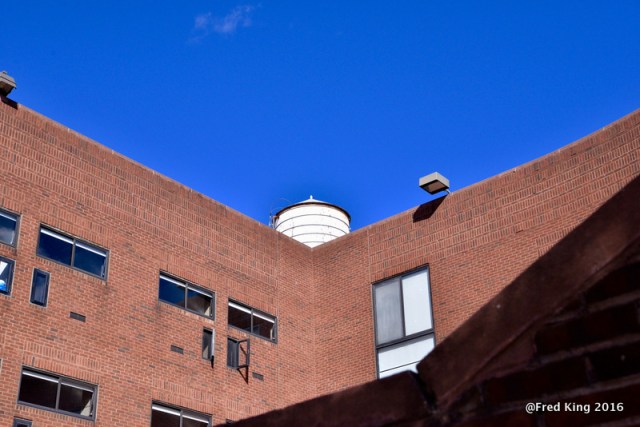
Location: LES, Manhattan.
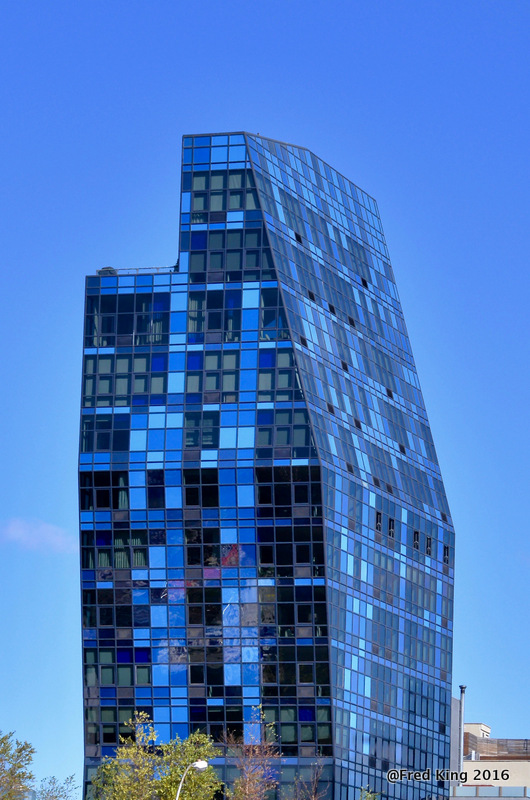
New construction in the Lower East Side, Manhattan.


This station is the end of the F and G lines. Subway trains pull inside the large covered area and then proceed to head out in the opposite direction. The station actually faces Surf Ave. but for whatever reason, it is named Stillwell Ave. Station. I think the station got a major facelift a few years ago. Stillwell Ave. may be the street on the left ( as you look at this image) of the Station. I have entered and exited from both sides and they both work just fine, however more shops can be seen if you enter via Surf Ave. You can imagine the throngs of people heading to the beach in the summer, cascading out of the two exits. In October it is deserted, aside from a few odd travelers such as myself :-).


As odd as it may seem, film crews do a lot of shooting around the Gowanus Canal. This set took up quite a bit of space, with catering and support vehicles and all. There is still a graphic book available, called It Came from the Gowanus Canal, for $5. which makes sense, but a film setting seems a bit weird. Usually there is always filming done in Brooklyn Heights, a much more scenic place in Brooklyn. The series Point of Interest was always shooting in Brooklyn Heights, it seemed.
Anyway, I included the image of the church steeple across the canal, closer to Carroll Gardens and this corner shot, as well.


Gowanus Canal: Two ways of looking at the Superfund Site.


The Gowanus Canal can be a very picturesque place or, depending on the light and your vantage point, it can be a pretty sketchy place with an aroma you will never forget.
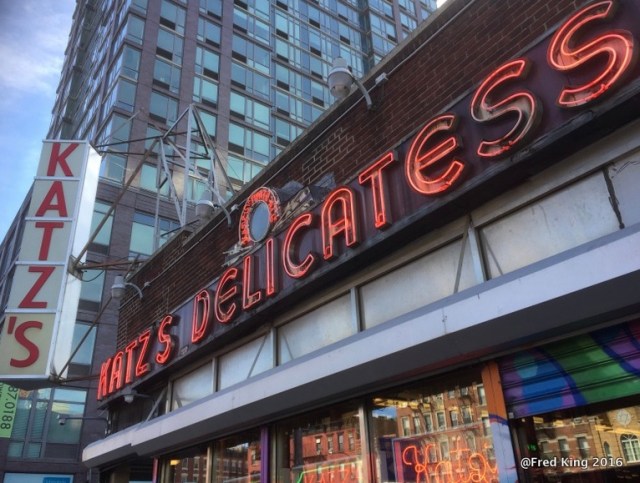


The Metropolitan Museum, path in Central Park, Katz’s Deli and Brooklyn Bridge.
Various iconic places in NYC.


Two iconic buildings in Brooklyn. The Brooklyn Public Library and The Old Stone House in Park Slope right across the street from where our son and family live.Both of these images were taken on my iPhone. Every Saturday there is a Farmers/Saturday Market in front of the Library and entrance to Prospect Park and Grand Army Plaza , a confluence of interesting sites to visit. The morning we were at the Market a man with a green flag ran up the steps leading to the library entrance and started waving this flag. I have no idea what it was about, but someone was videotaping his actions. ??
 On a very blustery morning. Walking the Brooklyn Bridge Park this morning and took this shot of Manhattan across the East River.


Another blogger, SunandGold, recently did a posting from her time spent in San Francisco. Her interest and fascination with the city/culture was shared by me 45+ years ago. I promised I would post these photos from 1970 in one posting ( rather than individual posts that I did in the past) so she could get a slight inclination of what the city was like all those years ago, measured against her recent visit to the city.
If you look closely at the image of Vanessi’s you will see a woman walking alongside the building, having come down Telegraph Hill. The image below, looking up that same street, shows a lone man in a suit walking to work ( this was a morning shot). Anyway, two points:the woman is wearing a scarf. This type of dress or accessory died off or fell out of favor shortly after this time. Also, personally for me or about me, both of these images portray the individual /subject as being a small, insignificant part of the world they are captured in, in terms of composition. To this day I have continued this approach, portraying a sense of ‘aloneness’, in many street shots of people. It almost seems like an unconscious methodology or approach to people. Even in the most crowded of spaces, people find themselves isolated. The images with cars in them also help validate the point in time in which I shot these film images all those years ago.
I think the rest of the images are, for the most part, self explanatory. Of interest might be the image adjacent to the City Lights Bookstore. If you look at the reader board on the building you can actually read the band/musicians on the bill for that week, which in some sense helps to corroborate the time at which the image was shot. Keystone Korner was a great venue for catching current musicians such as Boz Scaggs and Bennhy Cecil and the Snakes! I think it was an over 21 club, but I could be wrong.
Thanks for going along for this short ride into the past with me!


I’ve taken photos of this former Vespa Club of Seattle building before. Now, there is a new mural on part of the wall so I thought it was worth another look.
 View of the EMP at the Seattle Center, a Frank Gehry design.


In a rundown state. Even the stained glass windows look like they have been neglected for some time.


In 1962 Seattle architect Paul Thiry did the design of some of the buildings at the Worlds Fair. Just as a side note, he also designed a house less than a mile from my home, on Marine View Drive, in Arbor Heights ( image above). The image of the NW Rooms refers to a series of rooms in a building Thiry designed. Today those rooms are no longer named NW Rooms, but are being used by SIFF and The Vera project, among others.
One of the rooms was called The Nisqually Room. In 1970, a band I was in played one or maybe two nights for some event ( I’ve been told it was a after-concert party for the All City Band in Seattle. I think we owed the music teacher of our high school a favor for letting us practice in his home basement and school music room. Mr. Terpenning was only a few years older than us and was supportive of what we were doing-which didn’t seem too odd at the time, but now……?). That was probably the largest room we ever played. The ceiling was so high the sound went everywhere at once and kind of morphed into something long and echoing.
The article in the link does not say what the Nisqually Room morphed into over the years. It may have been combined with an adjacent room. I have walked up and down the steps and around this set of rooms and my memory says one thing and the physical structures say another.
Anyways, I thought it was interesting that my history and that of Paul Thirys’ met 8 or so years after his design and contribution to the Worlds Fair in 1962.
Some of the Art Deco touches on the art museum in Volunteer Park, Seattle.
Committed to amplifying underground independent sounds.
We Live In A Dynamic Universe of Energy
Finding the Extraordinary in Ordinary, Everyday Life
The Dedicated Blog for Inga Maria Hauser
Taking Control... Learning Contentment
Street and Urban Explorer Photography
Just another WordPress.com site
The Truth Sets Us Free
A daily selection of the best content published on WordPress, collected for you by humans who love to read.
Street and Urban Explorer Photography
Child Abuse and the Occult
The Random Things We See
Street and Urban Explorer Photography



 Bluestar2012's Photoblog