In Distress

Gowanus Canal: Two ways of looking at the Superfund Site.

The Gowanus Canal can be a very picturesque place or,  depending on the light and your vantage point, it can be a pretty sketchy place with an aroma you will never forget.

Past and Present

Two iconic buildings in Brooklyn. The Brooklyn Public Library and The Old Stone House in Park Slope right across the street from where our son and family live.Both of these images were taken on my iPhone. Every Saturday there is a Farmers/Saturday Market in front of the Library and entrance to Prospect Park and Grand Army Plaza , a confluence of interesting sites to visit. The morning we were at the Market a man with a green flag ran up the steps leading to the library entrance and started waving this flag. I have no idea what it was about, but someone was videotaping his actions. ??

Under the Rail Bridge

At this spot on the Yakima River there is a rail bridge over a small stream that feeds into the river. A fun spot to explore, but not when a train is passing through.

TBT:A Glimpse Back in Time

Another blogger, SunandGold, recently did  a posting from her time spent in San Francisco. Her interest and fascination with the city/culture was shared by me 45+ years ago. I promised I would post these photos from 1970 in one posting ( rather than individual posts that I did in the past) so she could get a slight inclination of what the city was like all those years ago, measured against her recent visit to the city.

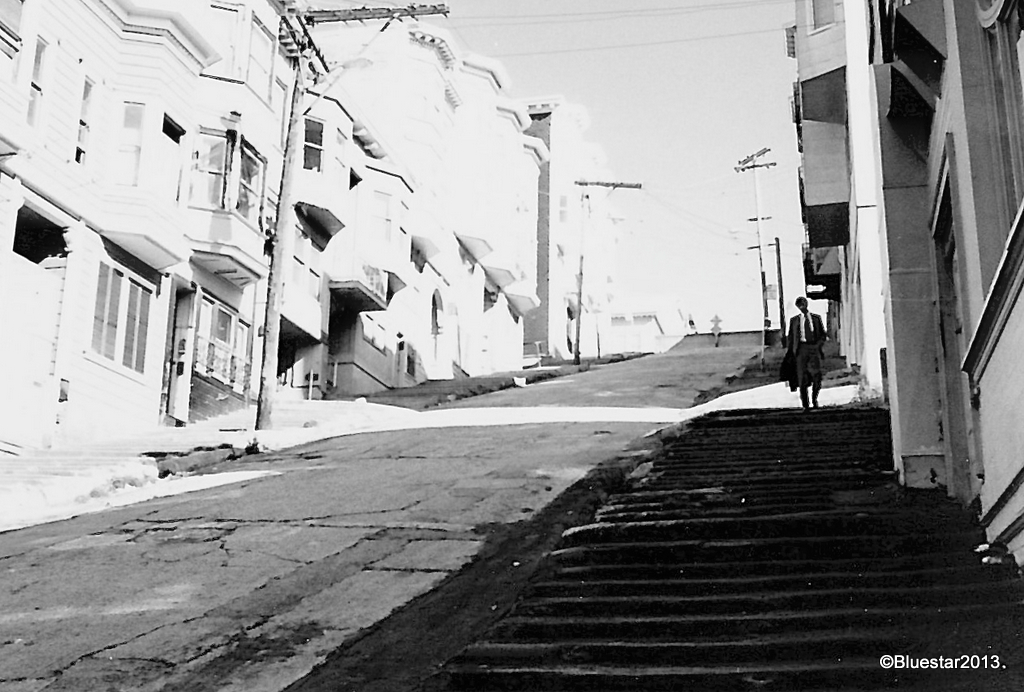
If you look closely at the image of Vanessi’s you will see a woman walking alongside the building, having come down Telegraph Hill. The image below, looking up that same street, shows a lone man in a suit walking to work ( this was a morning shot). Anyway, two points:the woman is wearing a scarf. This type of dress or accessory died off or fell out of favor shortly after this time. Also, personally for me or about me, both of these images portray the individual /subject as being a small, insignificant part of the world they are captured in, in terms of composition. To this day I have continued this approach, portraying a sense of ‘aloneness’, in many street shots of people. It almost seems like an unconscious methodology or approach to people. Even in the most crowded of spaces, people find themselves isolated. The images with cars in them also help validate the point in time in which I shot these film images all those years ago.


I think the rest of the images are, for the most part, self explanatory. Of interest might be the image adjacent to the City Lights Bookstore. If you look at the reader board on the building you can actually read the band/musicians on the bill for that week, which in some sense helps to corroborate the time at which the image was shot. Keystone Korner was a great venue for catching current musicians such as Boz Scaggs and Bennhy Cecil and the Snakes! I think it was an over 21 club, but I could be wrong.

Thanks for going along for this short ride into the past with me!

Horizontal

Version 2

I dug around in my lens collection last week and found a 50mm 1.8 Nikon lens I hadn’t used in years, if ever. I was watching a video lesson online about street photography and the photographer was using a 50mm lens, which is something I haven’t thought to do when I do street shooting. The lens forces you to get a little closer to your subject, but the results seem pretty cool. So…. this was my first foray into playing around with an old lens. I was pretty happy with the results. Since it is a prime lens and not a zoom, you do all of your focusing with your feet as opposed to the lens. That was one or the points I remember from a photography class I took with The Mountaineers nearly ten years ago; one of the guest lecturers pushed the point the ‘focussing with your feet’ is the best approach in some situations.

Sage advice. If anyone in Seattle is ever interested in a one week photo workshop I highly recommend the one The Mountaineers put on. Very reasonable price-wise and just really interesting classes as well as a field trip every Saturday or Sunday. I’ll never forget my experience. I was, at that time, about the only person in the 100 group that shot in film! I was using my Minolta X700 and everyone else had digital cameras. But, that was okay. I needed more film time and the info transfers pretty good to the digital format.

History Intertwined

IMG_2127

In 1962 Seattle architect Paul Thiry did the design of some of the buildings at the Worlds Fair. Just as a side note, he also designed a house less than a mile from my home, on Marine View Drive, in Arbor Heights ( image above). The image of the NW Rooms refers to a series of rooms in a building Thiry designed. Today those rooms are no longer named NW Rooms, but are being used by SIFF and The Vera project, among others.

One of the rooms was called The Nisqually Room. In 1970, a band I was in played one or maybe two nights for some event ( I’ve been told it was a after-concert party for the All City Band in Seattle. I think we owed the music teacher of our high school a favor for letting us practice in his home basement and school music room. Mr. Terpenning was only a few years older than us and was supportive of what we were doing-which didn’t seem too odd at the time, but now……?). That was probably the largest room we ever played.  The ceiling was so high the sound went everywhere at once and kind of morphed into something long and echoing.

The article in the link does not say what the Nisqually Room morphed into over the years. It may have been  combined with an adjacent room. I have walked up and down the steps and around this set of rooms and my memory says one thing and the physical structures say another.

Anyways, I thought it was interesting that my history and that of Paul Thirys’ met 8 or so years after his design and contribution to the Worlds Fair in 1962.

Same River, Sixty One Years Later

The photo on the left is of me in 1955 taken along the Duwamish River in South Park, Seattle, where we lived at the time. The photo on the right is of my grandson taken this week along the same river. Some things don’t change too much over time.

The House on the Hill: Pt. II

This slideshow requires JavaScript.

My second visit to the House on the Hill in South Park, Seattle. Due to waist-high debris it was impossible to get more than a couple of feet inside the house. The interior is severely burned; it smells and is very unsafe. On the outside there is broken glass everywhere in addition to piles of debris. At one time this was a house with a view of Downtown Seattle in the distance as well as the Duwamish River nearby. I don’t know what “Skin Trap House” means, so if anyone has any ideas…. feel free to comment. The ground floor of the interior looks more like a dumping ground than anything else; perhaps after the fire people just repurposed the house? A good percentage the debris is not fire damaged. The image of the stairs leading to the second floor I found most appealing and engaging.

South Park

DSC_6923-001

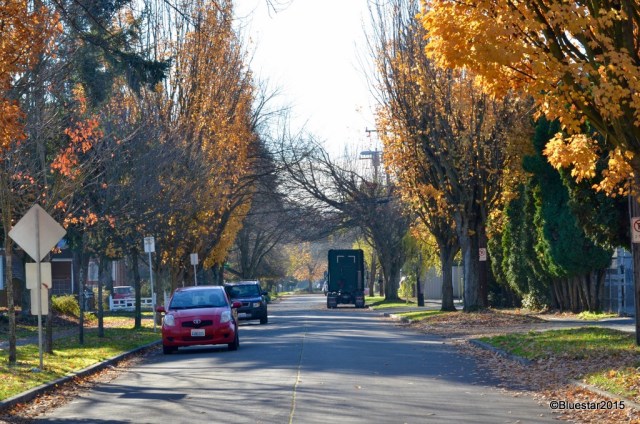
Fall colors line this street in South Park, Seattle. I lived in South Park between the ages of 3 and 5.IMG_0001 - Version 2

South Park: fishing in the Duwamish River in South Park in 1955.

Full Circle

DSC_8754 - Version 2 IMG_0005 - Version 2-001

Two images, nearly 45 years apart, explore the same theme. One way to portray the human sense of aloneness is to put the subject alone in a large context, almost to the point of being almost meaningless, hard to find. The subject in this context is either not whole ( as in the Coney Island image) or is stepping into the shadow ( as in the Telegraph Hill image from 1970). Most photographers would explore this theme by focussing closely on the subject, as in a portrait with certain facial expressions to convey the theme. In both of these images the viewer is forced to look longer and closer to find the subject. To further emphasize the theme I picked places that are normally associated with lots of human traffic and times when that traffic might be minimal or non-existent.

Just as an aside: To shoot both of these images I used the same strategy, that is planting myself and camera in a location, waiting for the image/shot to come to me. This, too, is contrary to what is generally taught in photo classes; they always stress scouting your location ahead of time and going out with a plan of what you want to shoot. All good and well, but sometimes breaking the rules allows for surprising results.

Normally I let my images do the “talking” and let people decide what they see and how they see it. With these two images I got a sense of personally coming full circle, something a few words, would help to explain how they came about and how my perceptions are formed.

More like a Journal Entry….

image

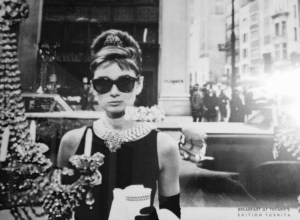
Thirty years ago I bought this poster from a poster and frame shop on Capital Hill, in Seattle. I had it mounted into a plexiglass cover. The minute I saw it I knew I wanted to buy it. I didn’t have my checkbook on me so drove home and back to the shop. A week or so later I picked up the finished item.

Although an iconic movie print, it has always meant much more to me. Audrey Hepburn exemplified grace and dignity. A wonderful actress who had a pretty scary childhood, she seemed to meet each challenge with pluck and a steely determination. Her last years, while battling ovarian cancer, were spent volunteering her services in Africa. By then she was nearly as skeletal-looking as the children she reached out and touched, yet she endured and shone like a beacon of hope to those children. She died much too young, at age 63. I am 63.

In the last thirty years she has kept me company and reminded me that, although we all have personal and health issues, we can still carry ourselves with grace and dignity and treat others with needs the same.